
Intro
Many customers who want to open an injection mold business may be puzzled: why is it that mold manufacturers can hardly find a uniform price for injection molds on e-commerce product pages, official website price lists, or offline brochures?
Is this a case of manufacturers deliberately hiding prices, trying to charge exorbitant prices and cater to different customers? Or is there too much inside information in the industry, making them afraid to put their prices on the table?
In fact, the fact that injection mold manufacturers do not have transparent pricing is not due to deliberate concealment by the manufacturers, but rather an inevitable result determined by the characteristics of the industry, product attributes, and cost structure.
Rather than saying “I don’t want everyone to know,” it’s more accurate to say “I can’t set a fixed price and I dare not quote a price arbitrarily.”
Why can’t injection molds be priced transparently?
First, injection molds are custom-made products and lack a standardized pricing basis.
Daily necessities, home appliances, hardware and other spot goods can be clearly priced because they have standardized specifications, fixed materials, controllable production capacity, and can accurately calculate costs and selling prices.
But injection molds are completely different. They are one-to-one non-standard customized products. There are no two molds that are exactly the same, so a fixed price cannot be applied.
1. The shape of the product determines its structural complexity
The mold structures for ordinary flat plastic parts and precision parts with undercuts, deep cavities, and multiple parting surfaces are vastly different.
Simple molds may cost only tens of thousands of yuan, while complex molds with sliders, core pulling, and hot runners can easily cost hundreds of thousands or even millions of yuan, with a price difference of more than ten times.
2. Size and specifications affect material costs
The molds for mini electronic components and those for car bumpers and home appliance casings differ greatly in size and steel usage, resulting in a difference of several times in raw material costs alone.
3. The number of cavities determines the production capacity and cost
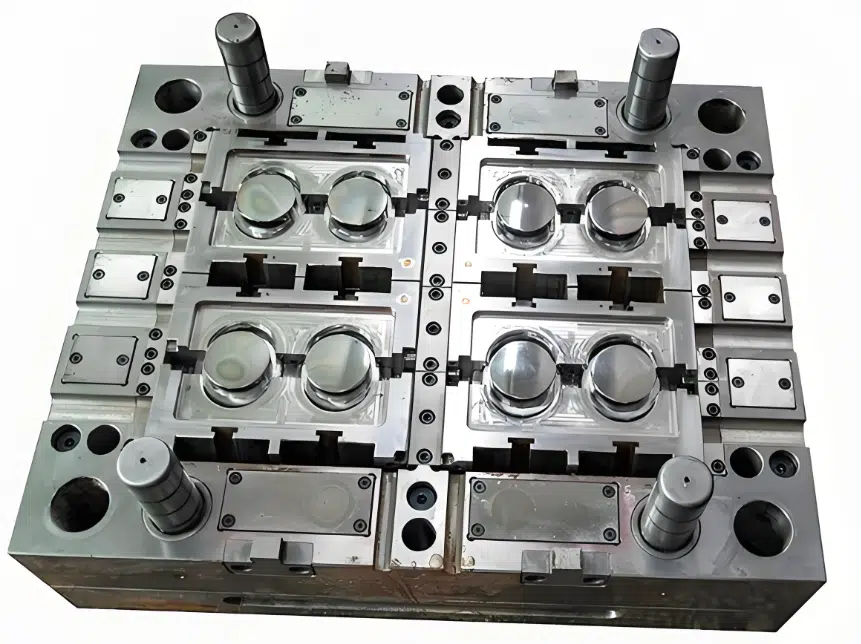
The design difficulty, processing time, and manufacturing cost of single-cavity molds and multi-cavity (8-cavity, 16-cavity, 32-cavity) mass production molds increase dramatically, and their prices are completely different.
Without standardized product templates, there is no standardized pricing system. Manufacturers cannot provide a uniform price in advance and can only calculate it individually based on the customer’s product needs.
Secondly, there are too many price variables, and even slight differences can alter the total cost.
The pricing of injection molds involves a comprehensive calculation system encompassing materials, processes, precision, after-sales service, and risks. Even for the same product, a change in just one parameter can cause significant price fluctuations. The core variables mainly fall into these categories.
1. The grade of steel determines the base price
Mold steel is divided into ordinary carbon steel, pre-hardened steel, mirror polished steel, and imported high-temperature resistant steel, with prices varying by 3 to 10 times.
The steel used to make a mold with a lifespan of 100,000 cycles versus 1 million cycles is vastly different; transparent and high-gloss parts require mirror-finish steel, which significantly increases costs. Manufacturers cannot price steel based on a single material; they must select materials according to their specific needs.
2. The price premium doubles due to the level of precision
For ordinary toy molds and medical and automotive precision molds, the precision requirement has increased from 0.1mm to 0.01mm. The processing equipment has been upgraded from ordinary milling machines to CNC machining centers, mirror EDM machines, and wire EDM machines, resulting in a doubling of labor time and equipment costs.
Surface texture, polishing level, exhaust system, cooling water circuit design—every optimization must be factored into the cost.
3. Hidden costs cannot be ignored.
Optional features such as hot runner systems, positioning devices, self-locking mechanisms, and safety protection devices will increase the price.
The number of trial moldings, mold modification services, warranty period, on-site debugging, and lifetime maintenance are also part of the price. While the price difference between low-priced bare molds and all-inclusive service molds may seem large, the actual difference lies in their cost structure.
4. Rush orders have significantly higher prices.
For regular delivery times and expedited orders, manufacturers need to allocate manpower, work overtime, and prioritize machine scheduling, which will increase costs. Small-batch trial production molds and large-batch mass production molds have different design concepts and material standards, resulting in different quotations.
Thirdly, there are industry rules and regulations.
Putting cost factors aside, the injection mold industry does not use transparent pricing in order to avoid risks and ensure the quality of cooperation.
1. Avoid low-price traffic acquisition traps
If manufacturers list low prices, but then raise prices due to changes in demand during actual production, disputes are likely to arise. Some unscrupulous businesses attract customers with extremely low prices, then cut corners and use inferior materials, damaging the industry’s reputation. Avoiding arbitrary pricing is the key to preventing cutthroat competition.
2. Prevent competitors from engaging in malicious price comparisons
Mold pricing includes soft power factors such as design, craftsmanship, and after-sales service; simply comparing prices is meaningless.
Publicly listing prices makes it easy for competitors to undercut prices, leading to the bad driving out the good. Ultimately, customers end up with cheap, low-quality molds, resulting in higher costs for mold repair and scrapping later on.
3. Accurately match customer needs
Blindly quoting prices can either scare away customers with excessively high quotes or result in losses by accepting orders that are too low, or even sacrifice quality to control costs. Communicating needs and evaluating solutions first, followed by a precise quote, ensures that customers spend their money wisely while also guaranteeing mold quality and consistent delivery.
How can you get a reliable quote?
Since injection molds cannot be priced transparently, if you want to get quotes efficiently and avoid pitfalls, just follow these steps.
First, provide complete information: 3D drawings/samples of the product, material requirements, precision standards, mold life, production capacity needs, delivery time, and after-sales service; avoid vague inquiries to obtain an accurate quote.
At the same time, don’t just focus on the price; pay attention to the details of the quotation, such as the steel type, processing technology, number of trial runs, and warranty terms. A transparent quotation is far more reliable than a low price.
The “no-price” policy in the injection mold industry is never a way for manufacturers to hide their profits or seek exorbitant gains, but rather a rational choice for the non-standard customization industry.
The price of each mold corresponds to its exclusive design, materials, craftsmanship, and service, reflecting the cost of customized production.
Instead of worrying about why there isn’t a clearly marked price, it’s better to clarify your own needs and have in-depth discussions with the manufacturer to find a solution. This will not only get you a reasonable quote but also ensure that the mold is easy to use, durable, and avoids pitfalls.
