
Introduction
Mold development cycle is a key indicator for product initiation, mass production scheduling, and project cost accounting, and it is also one of the core issues that customers are most concerned about.
This article will break down the entire development process of injection molds, sort out the overall time standards for conventional molds, complex molds, and expedited molds, and clearly answer the question of how many days are required for the complete development of a mold.
Full Development Process of Injection Molds
Based on the complexity of the product structure, the industry divides the injection mold development cycle into three tiers, covering the vast majority of mold-making scenarios for plastic products.
The entire process of a standard simple injection mold takes 20–30 days and is suitable for single-cavity molds with simple structure, no complex undercuts, and no special appearance processes.
The entire process of medium-complexity precision molds takes 30–45 days and is suitable for appearance parts with slides, angled ejectors, textured and polished surfaces, as well as conventional molds with multiple cavities.
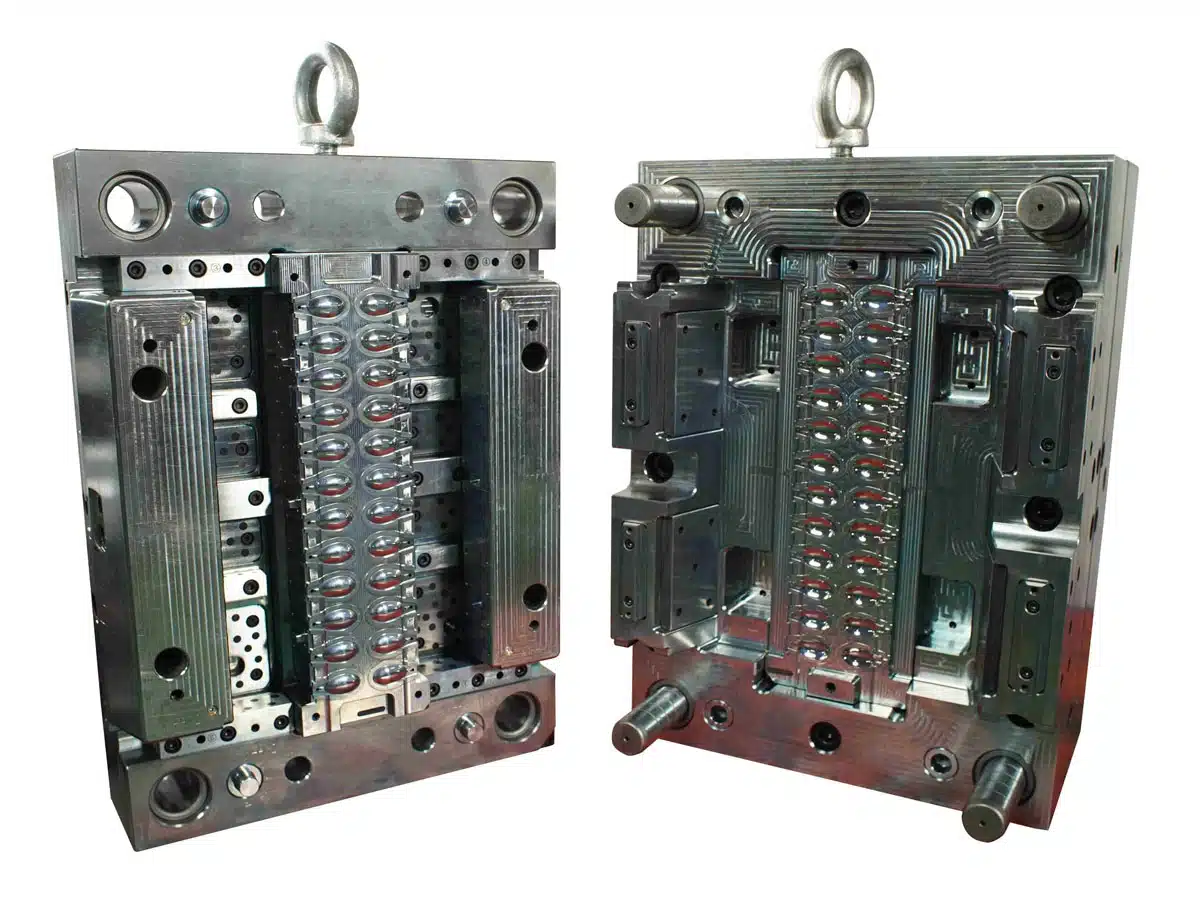
The entire process of high-precision complex molds takes 45-70 days and is suitable for high-end mass production molds with deep cavities, thin walls, multiple core-pulling structures, transparent mirror surfaces, and needle valve hot runners.
The entire development process is divided into four stages: mold design, steel preparation and rough and fine machining, mold assembly and matching, and trial molding, rectification and delivery. Each stage is closely linked, and the overlapping of the stages constitutes the overall mold opening cycle.
Detailed breakdown of time consumption for each stage
Phase 1: Mold Design Phase (2–7 days)
Mold design is the first step in mold making, which directly determines the subsequent processing accuracy and product molding effect. It mainly includes the entire process of product analysis, DFM review, 3D structural design, 2D drawing, and drawing confirmation . The lead time varies depending on the complexity of the product.
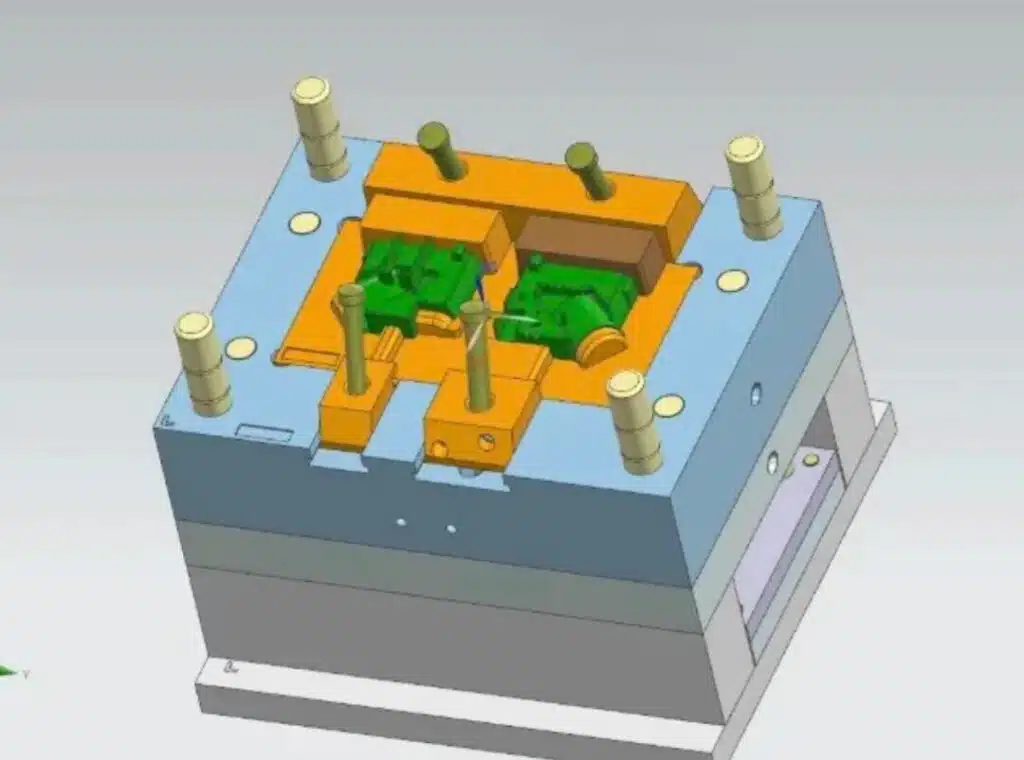
For simple planar products and single-cavity molds without special structures, the design process is simple, requiring only the basic design of parting line, runner, and ejection system, and the overall time is 2-3 days.
For products with simple undercuts and a small number of sliding structures, it is necessary to refine the core-pulling structure and demolding system, and at the same time complete the customer’s DFM structure confirmation. The lead time is about 3-5 days.
For molds with complex multi-cavity shapes, multiple sets of inclined ejector slides, irregular curved surfaces, and high-precision appearance requirements, it is necessary to repeatedly optimize the parting surface, adjust the injection position, and verify the demolding stroke. The drawing review process is more rigorous, and the design cycle can reach 5-7 days.
The core reason for the fluctuation in the project timeline at this stage is the efficiency of customer confirmation. If customers frequently modify product drawings and adjust appearance and size standards, it will directly lengthen the design cycle, resulting in a delay in the subsequent processing time.
Phase Two: Mold Frame and Mold Core Machining (10–45 days)
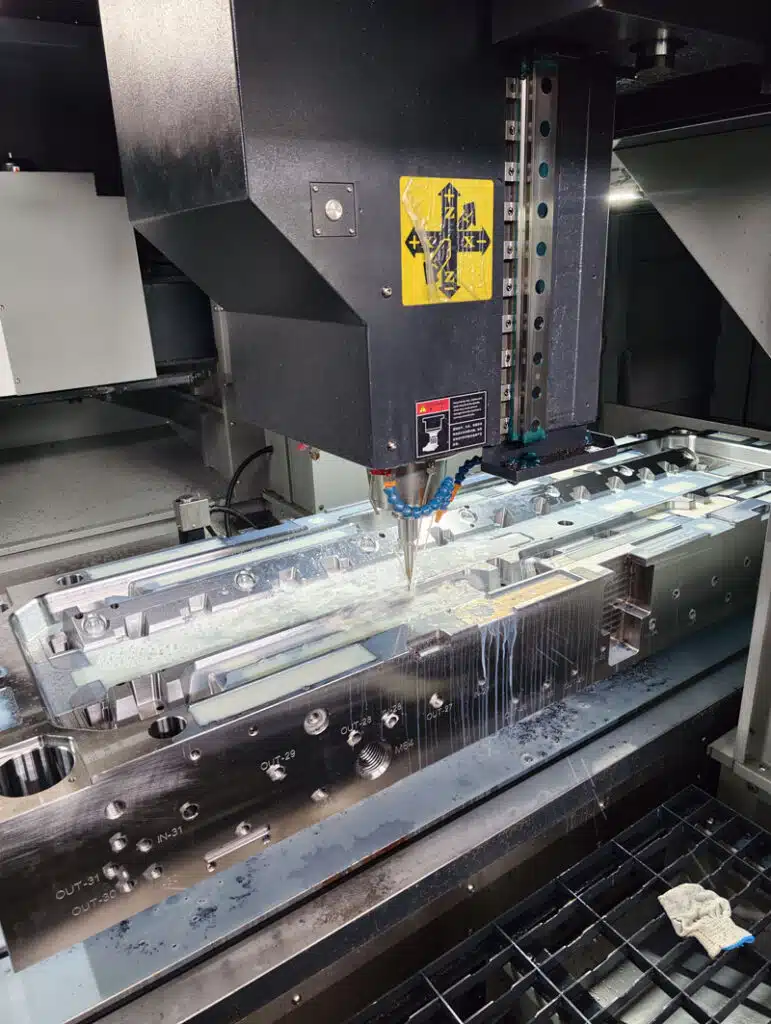
The processing stage is the core stage with the longest development time and the most processes in the entire mold development process, accounting for more than 60% of the overall project time. It includes all processes such as mold frame customization, mold core steel preparation, rough machining, fine machining, heat treatment, and surface treatment . It is also the stage with the biggest difference in project time between simple and complex molds.
The processing cycle for simple molds is 10–15 days. They use standard mold frames and ordinary P20 steel, without complex heat treatment or special surface processes. They only require basic CNC roughing, precision milling, drilling, and hole fitting, which are conventional processes. The processing difficulty is low, the processes are concentrated, and the delivery speed is fast.
The processing cycle for medium-complexity molds is 15–30 days. They mostly use pre-hardened steel mold cores and require multiple processes such as CNC precision machining, EDM electrical discharge machining, wire cutting, and precision grinding. Some molds require tempering heat treatment and ordinary texturing processes. Multi-cavity molds also need to ensure the alignment accuracy of each cavity, which greatly increases the processing time.
The processing cycle for high-precision and complex molds can reach 30–45 days. They are mostly made of high-end steel such as S136 and STAVAX, and require hardening processes such as vacuum quenching and nitriding. They are also finished with appearance processes such as high-gloss mirror polishing and fine etching.
Complex irregular structures and deep cavity thin-walled locations require multiple discharges and repeated fine-tuning, resulting in an extremely low machining error tolerance. Furthermore, the customization and adaptation of needle valve hot runners also consumes a significant amount of time.
Phase 3: Mold assembly and matching debugging phase (3–8 days)
After all parts of the mold are processed, the overall assembly, parts matching, and pre-processing and debugging stages are entered. These stages mainly include mold core closing, slide and ejector assembly, guide pillar and guide assembly, ejection system debugging, hot runner and temperature control system wiring matching, and mold closing gap calibration , to make full preparations for mold trial.
The simple mold has a simple structure, few parts, and no complicated core-pulling structure. It is easy to assemble and can be fully assembled and self-tested in just 3-4 days.
Molds with multiple sliding positions, inclined ejectors, and multiple cavities require high precision in assembly and alignment, and have complex parts. It is necessary to debug the motion structure one by one and troubleshoot jamming and gap problems. The production time is about 4-6 days.
High-end molds equipped with hot runner systems and timing control structures require additional adjustments to the temperature control system, injection timing, and valve needle opening and closing accuracy, with the overall assembly and debugging cycle reaching 6–8 days.
Phase 4: Trial molding, rectification and delivery phase (3–10 days)
Trial molding is the final step in verifying the molding effect, dimensional accuracy, and mass production stability of the mold. It is also a critical rectification stage before mold delivery. The process typically includes the first trial molding, sample testing, problem rectification, second trial molding, and sample confirmation and delivery.
The standard mold with a simple structure can produce qualified samples on the first trial molding. Only simple minor adjustments to the size and trimming of burrs are needed. The overall trial molding delivery cycle is 3-5 days.
Most conventional molds will have minor shrinkage, flash, dimensional deviation, uneven glue injection, etc. during the first trial molding. Targeted mold repair and a second trial molding are required, with a production time of about 5-7 days.
Final Words From Diamod Mold
Complex and precision molds, and products with extremely high appearance requirements, are prone to problems such as uneven runners, demolding jams, mirror-like defects, deformation, and warping. These issues require multiple structural repairs, adjustments to process parameters, and repeated trial molding verifications, with trial molding cycles lasting 7–10 days. If product structural defects or modifications to the core mold structure are involved, the lead time will be further extended.
Meanwhile, the industry supports expedited production. Through parallel design and processing, priority scheduling, and multiple shifts working overtime, the production time for simple molds can be compressed to 15-20 days, and for medium-sized molds to 20-30 days. However, high-end, complex, and precision molds cannot be significantly expedited due to the inability to reduce processing steps and process requirements.
A clear understanding of the production schedule at each stage of mold making allows for precise alignment with product mass production plans and reasonable control over mold opening progress and project milestones.
