
Brief Intro
Many customers are confused when making injection molds: the mold fee is higher for smaller products than for larger products. Is there something fishy going on behind this?
In fact, the pricing of injection molds is not determined by size alone, but by the combined effect of multiple core factors such as precision requirements, structural complexity, and material selection.
The following analysis will delve into the underlying logic of this phenomenon, helping you to see the cost structure and industry truth behind mold-making fees.
The reason why mold opening fees are higher for smaller products
Injection molds are high-precision, customized production tools, and their cost structure is completely different from the traditional manufacturing logic of “raw material weight determines price.” The higher mold-making fees for smaller products often stem from the following three factors.
1, Higher precision requirements
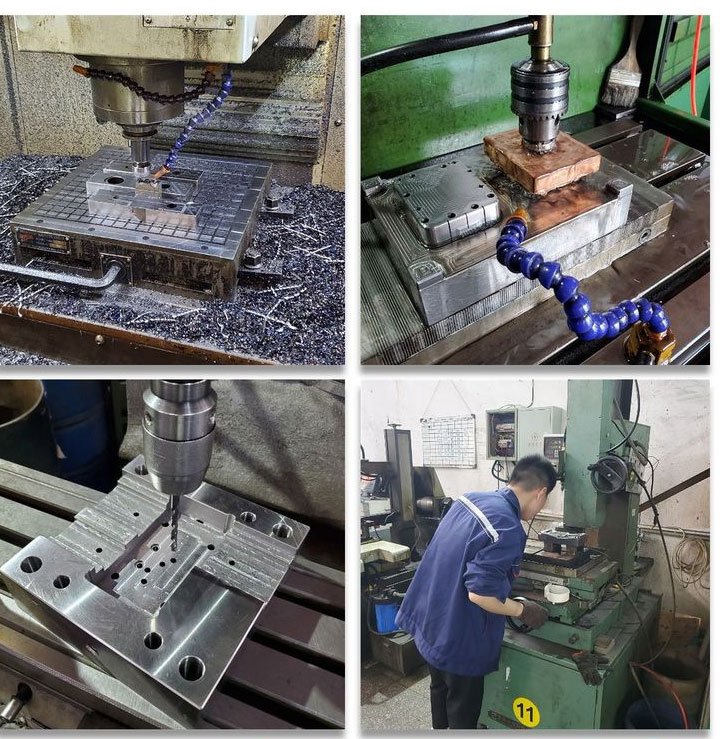
If the dimensional tolerance requirements for small products are high, high-end equipment must be used in mold manufacturing, such as a five-axis CNC machining center to achieve three-dimensional curved surface cutting, and a slow wire EDM machine to handle narrow slit structures, which also results in higher costs.
In contrast, large products have lower tolerance requirements, such as ±0.05-0.1mm, which can be met by ordinary processing equipment, resulting in significantly lower equipment depreciation and processing time costs.
More importantly, the difficulty of machining the cavity of small products increases exponentially.
For example, machining a 5mm diameter micro-hole requires specialized micro-tools for deep cavity processing, resulting in tool wear 3-5 times higher than conventional machining. Furthermore, each process necessitates point-by-point inspection using a coordinate measuring machine, with a single inspection taking over an hour, leading to persistently high labor and equipment costs.
2, Complex structure
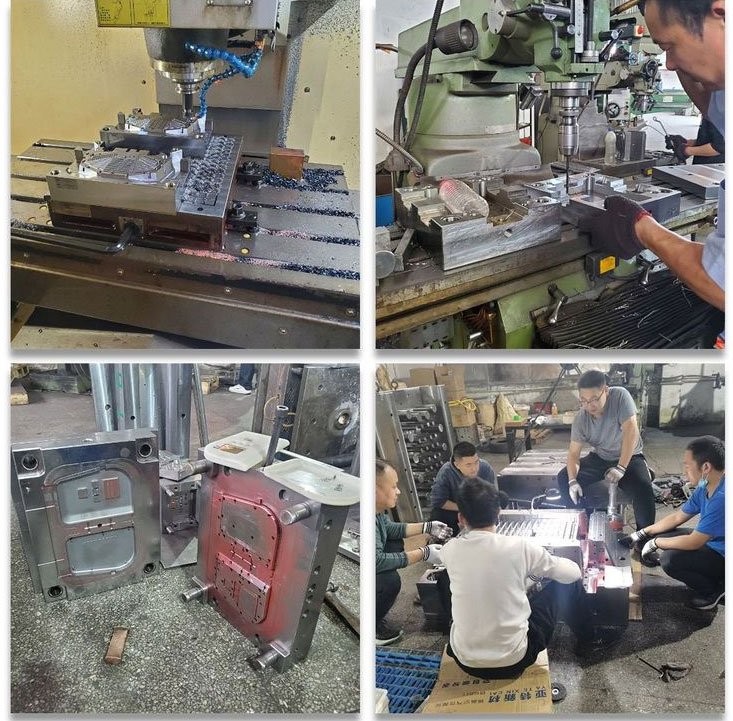
To achieve their functions, many small products often contain complex structures such as multiple sets of undercuts, angled holes, and threads. They require the design of mechanisms such as sliders, angled ejectors, and core pulling within a limited space, and even the integration of hot runner systems, which results in relatively high design and manufacturing costs.
Large products typically have flat or simple curved surfaces, resulting in relatively simple demolding mechanisms that do not require complex spatial layout optimization, thus reducing design and manufacturing costs.
3, High requirements for material selection and surface treatment
Small, precision products are often used in high-end applications, which places stringent requirements on the wear resistance, corrosion resistance, and surface smoothness of mold materials.
The mold cores for mass-production molds require imported alloy steel (such as Swedish S136), which costs 3-5 times more than ordinary carbon steel. Furthermore, they need to undergo multiple heat treatments including quenching, tempering, and nitriding, further increasing processing costs.
Molds for large products are mostly made of domestic P20 steel, and surface treatment only requires ordinary polishing. The difference in material and processing costs can be several times.
How can I tell if there’s something fishy about the mold-making fee?
Not all “high prices for small products” are reasonable. You need to use the following three points to accurately identify them and avoid falling into a trap.
1, Verify the reasonableness of the cost structure.
Request suppliers to provide a detailed breakdown of quotations, with particular attention to:
Does the material cost account for less than 15% of the total cost? If it is too low, ordinary steel may be used instead of special steel, causing the mold life to plummet from 500,000 cycles to 10,000 cycles.
Is the processing fee an abnormally high percentage? If there’s no complex structure but the processing fee claims to exceed 50%, a list of processing steps and equipment models must be provided.
Does the trial molding fee specify the number of trials? If it doesn’t specify the number of free trials (the industry default is 2-3 trials), there’s a risk of additional charges later.
2, Benchmark against industry price ranges and technical standards.
Based on product type and industry average price (for reference only):
Simple small molds: USD 800 – 3,200
Precision small molds: USD 2,800 – 14,000
Large standard molds: USD 14,000 – 70,000
Large precision molds: USD 70,000 and above
If the quoted price is more than 30% lower than the average price of similar products, be wary of shoddy workmanship; if it is more than 50% higher than the average price, verify whether there is excessive configuration.
3, Clearly define the key binding clauses in the contract
To avoid hidden costs, the contract must clearly state:
For mold materials, if the steel grade is specified (e.g., S136), a material testing report is required.
Accuracy and lifespan commitments are made, clearly defining product dimensional tolerances and mold lifespan; failure to meet these standards requires free rework.
The responsibilities for trial molding and mold repair should be clearly defined, stipulating that trial molding continues until the mold is deemed qualified or acceptable, and specifying who will bear the costs of rework and material loss.
The after-sales maintenance terms should specify the warranty period (usually one year in the industry) and the cost of replacing easily damaged parts.
Summary
In short, the higher mold-making cost for small products compared to large products doesn’t necessarily mean the price is inflated. It’s more likely a necessary consequence of the triple requirements of “high precision, high complexity, and high reliability.”
For enterprises, before mold making, they should first clarify the product’s precision requirements, mass production scale, and usage scenarios, and work with suppliers to optimize the product structure (such as reducing unnecessary undercuts and simplifying cavity design), and achieve cost control through technical adaptation rather than simply lowering prices.
After all, a low-cost mold with a short lifespan and poor precision may lead to rework and scrap during mass production, ultimately resulting in losses far exceeding the initial savings in mold-making costs.
